Most director-level About sections on LinkedIn are either a dry CV summary or motivational waffle. Both fail the only test that matters: would someone reading this feel confident reaching out to you?
The About section sits in an odd space. It’s not a covering letter. It’s not your bio. It’s not an advert. But it needs to do a bit of all three whilst sounding like you actually wrote it.
Start with what you do, not who you are
Opening with “Passionate technology leader with 15+ years’ experience” tells nobody anything. Every director claims passion. Every director has experience.
Start instead with the problem you solve or the thing you build. “Scaling engineering teams in regulated environments” or “Building API platforms that don’t fall over” gives the reader an immediate reason to keep going.
This isn’t about being clever. It’s about respect for the reader’s time. They’re scanning dozens of profiles. Give them a reason to stop scrolling in the first sentence.
Your credibility comes from specifics, not adjectives
“Strategic thinker” and “innovative problem-solver” are filler. They sound like someone asked ChatGPT to write their profile.
Compare that to “rebuilt the deployment pipeline at Company X, cutting release time from three weeks to same-day” or “hired and scaled a team from four to thirty whilst keeping attrition below 8%”. The second version gives evidence. It lets the reader decide if you’re strategic or innovative.
At director level, you’ve done things worth mentioning. Mention them. Revenue numbers, team sizes, project outcomes, technical decisions that paid off. Keep it factual and it won’t read like boasting.
Open with a fact, not a vague claim
The same discipline applies to your opening line specifically. Most director-level About sections open with a job title and a general statement of experience — “Technology Director with 15 years leading engineering teams” tells the reader nothing they couldn’t guess from your headline.
Start with something concrete instead. A specific decision you made, a trade-off you’d make differently next time, a technology choice and its consequence. “Migrated a monolith to microservices three times in my career. Wouldn’t do it again unless the team size justified it.” That’s a position. It reveals judgement, and it starts a conversation rather than closing one.
Facts are more credible than claims because they can be challenged. Claims just slide past.
Write for two audiences at once
Your About section needs to work for recruiters who don’t understand the tech and for peers who absolutely do.
This means avoiding walls of jargon but also not dumbing down to the point of meaninglessness. “Cloud migration” could mean anything. “Moved 40 services from on-prem to AWS, including a zero-downtime cutover for the payment stack” works for both audiences.
The recruiter gets that it’s substantial work. The technical peer gets that you know what you’re doing. Neither feels patronised.
Show a bit of personality without performing it
There’s a fashion for ending LinkedIn profiles with “When I’m not coding, you’ll find me rock climbing” or similar. It usually feels tacked on.
If you’re going to include personal detail, make it do some work. “Spent lockdown rebuilding a 1970s motorcycle, which taught me more about project management than any course” connects a personal interest to professional credibility.
Or just skip it entirely. Nobody’s going to not hire you because you didn’t mention your hobbies. They might skip your profile if it reads like a dating app bio.
Make it easy to know what to do next
The end of your About section should tell the reader what happens if they reach out. Not in a pushy way, but clear.
“Happy to talk about API design, team scaling, or contracting opportunities in fintech” works. So does “Always interested in hearing from engineers looking at leadership moves”. Both give permission to message you and a rough topic area.
Leaving this vague means people won’t bother. They’ll assume you’re not actually open to contact, whatever your settings say.
Length matters less than structure
Some advice says keep it to 200 words. Some says go longer. The real answer is: use paragraphs.
A 400-word block of text is unreadable. Four 100-word paragraphs with clear breaks is fine. LinkedIn lets people expand to read more, so front-load the important bits and let the rest unfold if they’re interested.
White space is doing half the work here. Let it.
Test it with the cold-open question
Read your About section and ask: if someone senior in my field read this cold, would they think “worth talking to” or “sounds like everyone else”?
If you’re not sure, send it to a peer whose opinion you trust. Not for proof-reading. For a genuine reaction to whether it sounds like you and whether it’s useful.
Most director-level profiles fail because they’re optimised for nobody. Too formal for humans, too vague for algorithms, too generic for genuine connection.
A strong About section does the opposite. It sounds like you. It gives evidence of what you’ve done. It makes it easy for the right people to get in touch.
That’s the whole job.
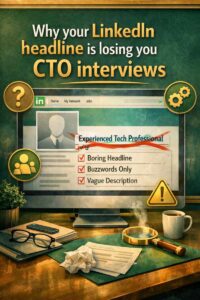
Getting the About section right is one part of the profile. If your headline still reads like a job title, why your LinkedIn headline is losing you interviews covers that, and how to get noticed by headhunters without looking desperate covers what to do with the profile once it is strong.