Most CTO LinkedIn profiles read like they were written by someone who's never hired a CTO. Generic job descriptions. Vague achievements. The same tired keywords everyone else uses.
The problem isn't that these profiles are bad. They're just invisible. And when a board member or exec search firm scrolls past your profile without stopping, you've lost an opportunity you didn't even know existed.
The hidden job market for senior tech roles runs almost entirely through networks and search firms. Your LinkedIn profile is doing work you never see. It's being assessed by people you'll never meet, often months before a conversation happens.
The headline that says nothing
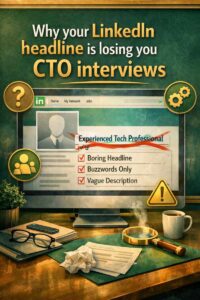
"CTO at CompanyName" tells me you have a title. It doesn't tell me what kind of CTO you are.
Compare that to "CTO scaling SaaS platforms for regulated industries" or "CTO specialising in engineering transformation at 200+ person scale". Specific beats generic every time.
Your headline appears in search results, connection requests, and comments you make. It's your handshake before the conversation starts. If it's just a job title, you're assuming people already know why they should care. They don't.
The fix is simple. State what kind of problems you solve or what kind of organisations you build technology for. Make it impossible to confuse you with the dozen other CTOs in the search results.
Experience sections that hide the actual work
"Responsible for technology strategy and delivery" appears on roughly ten thousand CTO profiles. It's wallpaper.
Search firms and hiring executives are looking for shape. They want to understand scale, complexity, and outcomes. They want to know if you've done the specific hard thing they need done.
Built a platform that handles 50 million transactions a day? Say so. Took a monolith to microservices with zero downtime? That's worth mentioning. Grew an engineering team from 12 to 80 people whilst maintaining delivery cadence? That's the detail that matters.
Numbers ground your experience in reality. Team size. Budget. User scale. Time to delivery. Revenue impact. These aren't bragging, they're context. Without them, your experience could mean anything.
The other gap most people miss is technology decisions. What did you choose and why? Moving from AWS to GCP isn't interesting. Moving from AWS to GCP to reduce data residency costs by 40% whilst meeting new regulatory requirements is a story that demonstrates judgement.
The ghost summary section
Half the CTOs on LinkedIn have no summary. The other half have something that was clearly written in 2014 and never updated.
Your summary does one job. It tells people who you are and what you're good at in a way that job descriptions can't. It's the only place you can speak directly about your approach, your philosophy, and the thread that connects your career choices.
This doesn't mean writing three paragraphs of leadership philosophy. It means explaining what kind of technology leader you are. Do you specialise in turnarounds? Building teams in high-growth environments? Taking products from concept to scale? Technology strategy for traditional businesses going digital?
The summary is also where you can mention things that don't fit neatly into job descriptions. Advisory work. Open source contributions. Speaking. Writing. The side projects that demonstrate how you think.
Skills and endorsements left to random chance
LinkedIn's skills section is messy and algorithmic, but search firms use it. So does LinkedIn's own search and recommendation engine.
If your top skills are Java, C++, and MySQL, you're signalling hands-on engineering. That might be accurate if you're still coding daily. It's probably not accurate for most CTOs.
Your skills should reflect what you actually do now and what you want to be known for. Architecture. Engineering leadership. Technology strategy. Cloud migration. Platform engineering. Technical due diligence. Regulatory technology. Whatever your actual domain is.
This matters more than it should because it's how you get found. Someone searching for a CTO with experience in fintech regulatory technology won't find you if your profile says Java developer who happens to work in finance.
Recommendations that don't say anything useful
"Great to work with. Highly recommended." Thanks, mum.
Good recommendations are specific. They describe a situation, what you did, and what happened as a result. They come from people whose judgement matters. A recommendation from your CEO about how you rebuilt the technology organisation carries weight. A recommendation from someone you haven't worked with in a decade less so.
You can't control what people write, but you can choose who to ask. And you can offer to write the first draft if someone's willing to recommend you but doesn't know what to say. Most people will gratefully accept.
Making the profile do its job
Your LinkedIn profile isn't your CV. It's not a complete record of everything you've ever done. It's a tool that helps the right people find you and understand quickly whether you might be worth a conversation.
That means being specific about what you do, showing outcomes not just responsibilities, and making it easy for someone to understand your shape in about 30 seconds of scanning.
Most senior tech exec opportunities don't start with a job posting. They start with someone thinking "I wonder if we know anyone who's done this before" and opening LinkedIn. If your profile doesn't make it immediately obvious that you're that person, the conversation happens with someone else.
If you're wondering whether your overall profile is positioning you effectively for the roles you want, the Authority Score Checker can give you a sense of where the gaps might be.
Frequently asked questions
What score should I be aiming for?
For actively searching senior professionals, 70 or above on a structured authority assessment is a reasonable target, with 85+ putting you in the top tier for visibility and credibility in most sectors.
Is it risky to optimise my profile while I'm still employed?
Colleagues can see profile edits if they check, but most senior professionals update their profile periodically regardless of job search status. If it's a concern, make the changes gradually rather than all at once.
How often should I update it?
Treat it as a living document. A quarterly review, plus an update whenever you deliver a result worth adding, keeps the profile current without turning it into a chore.
Do I need a professional photographer?
Not necessarily, but the photo needs to be current, well-lit and appropriately senior in tone. It's the fastest visual signal a recruiter reads before anything else on the page, and it's the one thing this piece hasn't covered yet.
The About section specifically deserves its own treatment — see what a strong About section looks like at director level for the structure and examples.