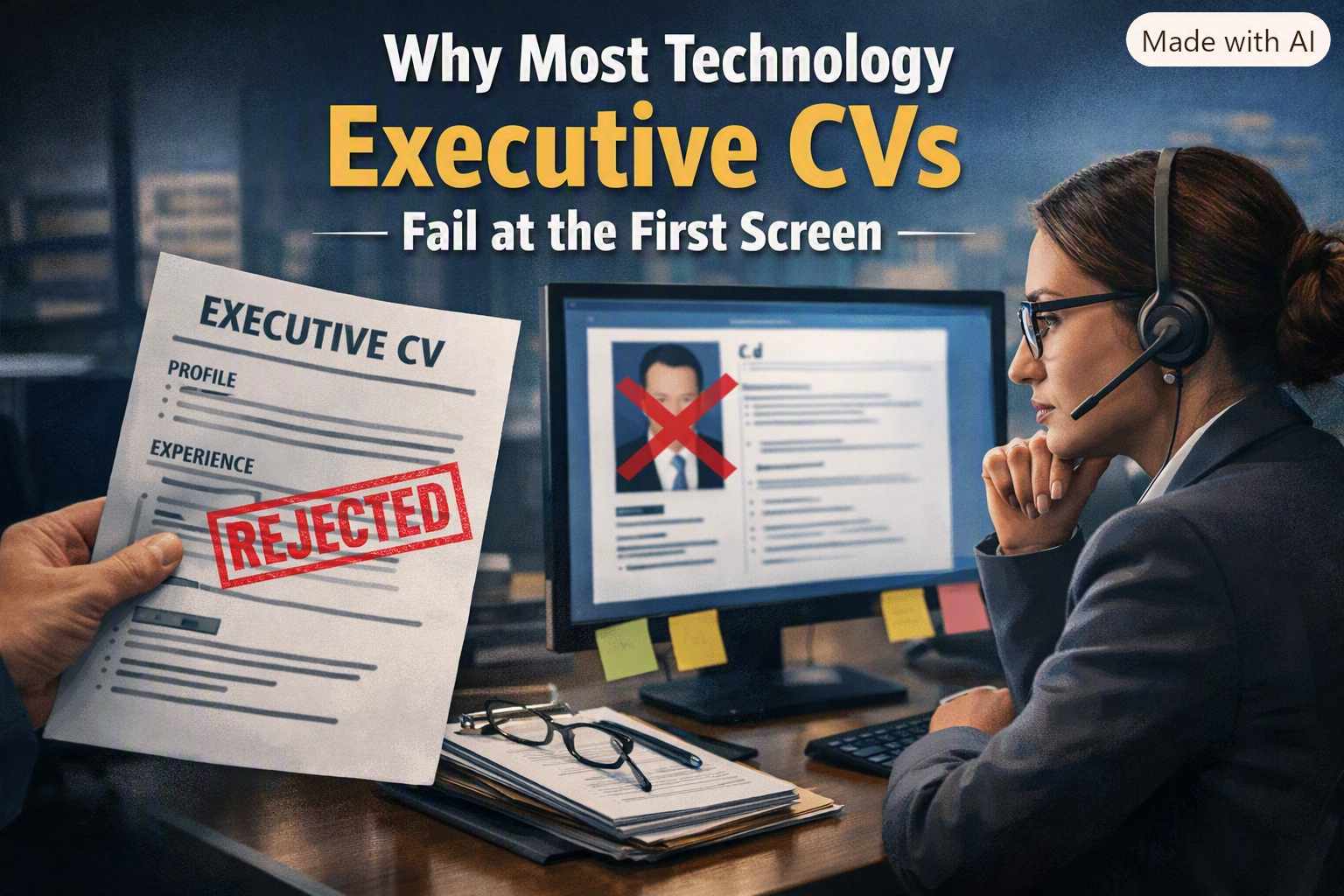
Most technology executive CVs in the UK don't make it past the first thirty seconds. Not because the candidate lacks capability, but because the CV is written for the wrong audience.
The problem is structural. Senior technologists write CVs the way they think about their work: detailed, chronological, comprehensive. But the person screening your CV isn't evaluating your technical depth. They're scanning for pattern matches against a brief they barely understand.
The recruiter problem nobody talks about
When you apply for a CTO or Director role at a scale-up or PE-backed business, your CV hits a recruiter's desk first. That recruiter is typically 26 years old, has never managed an engineering team, and is working from a list of keywords the hiring manager scribbled down between meetings.
This isn't a criticism. It's the economic reality of how executive hiring works in the UK market. The recruiter's job is to reduce a pile of 80 CVs down to 8. They have about 90 seconds per CV to make that call.
Your comprehensive, nuanced career narrative doesn't survive that filter. Pattern matching does.
What actually gets you through
The CVs that make it past initial screening have three things in common. First, they front-load business outcomes in language a non-technical reader can understand. Not "migrated monolith to microservices architecture" but "reduced infrastructure costs by £400k annually while improving system reliability."
Second, they match the language in the job description with almost suspicious precision. If the JD mentions "cloud transformation" three times, that exact phrase appears in your CV. If they want "experience scaling engineering teams," you don't write about "building technical capability" or "growing development capacity." You write the words they used.
Third, they make seniority immediately visible. Job titles, company sizes, budget responsibility, team sizes. All in the first third of the first page. Because the screener needs to confirm you're the right level before they read anything else.
The technical detail trap
Senior technologists tend to over-index on technical architecture decisions. Your CV explains the trade-offs between Kubernetes and ECS, or why you chose a particular observability stack. This information matters later in the process, but it actively hurts you at the screening stage.
Technical detail creates two problems. First, it takes up space that should be used for business context and outcomes. Second, it signals the wrong level. Individual contributors and Engineering Managers write about technology choices. CTOs and Heads of Technology write about the business problems those choices solved.
The technical depth proves itself in conversation. The CV just needs to get you into that conversation.
How UK executive CVs differ from US ones
If you've looked at American executive resume advice, ignore most of it. UK hiring culture is different in ways that matter for CV structure.
British recruiters and hiring managers expect chronological CVs, not functional ones. They want to see education, even for senior roles. They notice unexplained gaps more readily. The writing style that works in the US often reads as overselling in the UK context.
Two pages is still the standard expectation, though three is increasingly acceptable at executive level if the career justifies it. Going beyond three pages suggests poor editorial judgement rather than impressive experience.
The authority signal you're probably missing
Most technology executive CVs list work history and nothing else. But the CVs that punch above their weight include evidence of authority beyond the day job.
Speaking at conferences. Writing that's been published. Open source contributions that gained traction. Advisory roles. Non-exec positions. These aren't vanity additions. They're social proof that other people recognise your expertise.
For senior roles, especially at the CTO and Director level, hiring managers are conscious they're bringing in someone who will represent the company externally. Evidence you already do that elsewhere makes you less risky.
Testing your CV before you send it
The fastest way to improve a technology executive CV is to test it against the specific role you're applying for. Print the job description and your CV side by side. Highlight every key phrase in the JD, then look for the same language in your CV.
If there are gaps, you have two options. Either adjust your CV to include that language where it's truthfully applicable, or accept this role isn't a strong match for your background. Both are better than sending a CV that fails the pattern matching test.
The second test is the recruiter simulation. Give your CV to someone outside technology and ask them to spend thirty seconds identifying whether you're qualified for the role. If they struggle, your CV is written for the wrong reader.
Making this practical
Your CV needs to work as two different documents. The version that gets you through initial screening is optimised for keyword matching and rapid comprehension. The version that gets discussed in later interview stages can include more nuance and technical context.
The efficient approach is to maintain both. A detailed master CV that includes everything, and a trimmed version for applications that prioritises business outcomes and mirrors JD language. Each application gets a light customisation of the trimmed version.
This feels mechanical. It is. But it reflects how executive hiring actually works, not how we wish it worked.
Getting through the first screen is only step one — worth sorting the gaps that show up later in a CTO application and what actually makes a cover letter stand out.
If you want to see how your CV stacks up against the typical technology executive role requirements in the UK market, the JD Gap Analyser will show you exactly which elements are missing before you hit send.