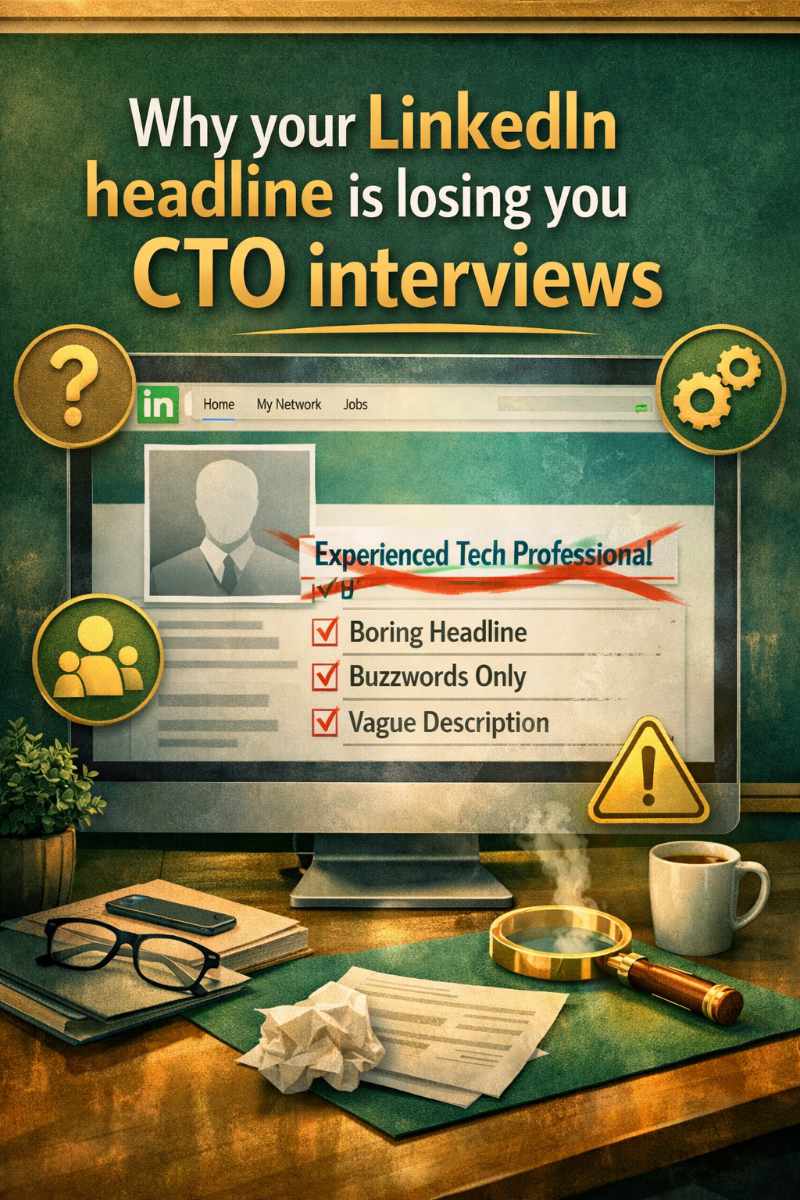
Most CTO LinkedIn headlines read like a checklist of buzzwords stitched together by someone who doesn't actually do the work. "Technology Leader | Digital Transformation | Innovation Driver | Passionate About Leveraging Cloud to Unlock Value." Recruiters scroll past these in milliseconds.
Your headline is the single most visible piece of text on your entire profile. It appears in search results, in connection requests, in comments you leave on posts. When a recruiter or hiring director searches for a technical leader, your headline determines whether they click through or keep scrolling.
Yet most senior tech leaders treat it as an afterthought. They default to job titles and vague platitudes, then wonder why the interesting opportunities aren't materialising.
What actually works in a CTO headline
The headline that gets you interviews contains three elements: specificity about what you've done, clarity about what you're solving, and enough detail that the right people recognise themselves in it.
Compare these two examples:
"CTO | Technology Leader | Driving Digital Transformation"
versus
"CTO scaling B2B SaaS platforms from £5m to £50m ARR | Built engineering teams from 8 to 85"
The first could be anyone. The second tells a hiring director at a scaling SaaS company exactly why they should message you. They can visualise the challenges you've solved because you've named them explicitly.
Specificity filters out the wrong conversations and attracts the right ones. When you're clear about your domain, your scale, and your results, you stop getting exploratory chats about things you'd never do and start getting proper approaches about roles that actually fit.
The job title trap
Many CTOs default to their current title as their headline: "Chief Technology Officer at CompanyName." This wastes 90% of your available characters and tells the reader almost nothing useful.
Your current employer's name is already visible directly below your headline. Repeating it adds no information. The title "CTO" on its own is so broad as to be meaningless. A CTO at a six-person fintech startup and a CTO at a 2,000-person enterprise software company do completely different jobs.
The headline space is 220 characters. Use them to communicate your actual value, not to restate what's already visible elsewhere on your profile.
Why vague feels safe but costs you opportunities
Generic headlines feel safer because they don't exclude anyone. "Passionate about technology and innovation" could theoretically appeal to any employer. But that's the problem. Recruiters searching for a CTO with deep experience in regulated healthcare technology will skip straight past you, even if that's exactly what you've done for the past eight years.
The fear is that specificity narrows your options. The reality is the opposite. Vague headlines mean you're invisible to everyone. Specific headlines mean you're highly visible to the people who actually matter.
A hiring director at a scale-up doesn't search for "technology leader passionate about innovation." They search for "CTO SaaS" or "technical leader fintech" or "platform engineering." If those words aren't in your headline, you won't appear in their results.
How to structure your headline for actual humans
Start with your role and the context that matters most. If you're a CTO, say so. Then immediately add the qualifier that narrows it down: the sector, the stage, the type of technology, or the scale you operate at.
Follow that with one concrete achievement or capability. Revenue growth, team scaling, technical architecture, product launches, cost reduction. Pick the thing that best demonstrates the value you create.
End with a secondary skill or focus area if you have space. This might be a technical domain, a leadership approach, or a particular type of transformation you specialise in.
The structure looks like this: Role + Context | Primary Achievement | Secondary Focus.
"CTO for venture-backed marketplaces | Scaled tech from MVP to 10m users | Platform architecture and team building."
"Technology Director in regulated financial services | Led cloud migration for legacy core banking systems | AWS and compliance-first engineering."
Both examples tell you immediately what this person does, who they do it for, and what they're good at. The reader can self-select in or out within three seconds.
Keywords matter more than you think
LinkedIn search is primitive but powerful. Recruiters search for exact phrases. If you work in SaaS, the word "SaaS" should be in your headline. If you've built AI products, "AI" or "machine learning" should appear. If you specialise in platform engineering, say "platform engineering."
This isn't about gaming an algorithm. It's about matching the language that hiring teams actually use when they're looking for someone like you. They're not searching for "technology visionary." They're searching for "CTO fintech" or "head of engineering e-commerce."
Look at the job specs for roles you'd actually want. Note the exact phrases they use repeatedly. Those phrases should appear in your headline.
Testing what works for you
The headline that works depends on what you're trying to attract. If you're open to board roles, mention governance or NED experience. If you're aiming at a specific sector, name it explicitly. If you've repeatedly delivered a particular type of transformation, lead with that.
Change your headline and watch what happens over the following fortnight. LinkedIn shows you who's viewing your profile. If you start getting more views from CTOs at similar companies, more approaches from relevant recruiters, and fewer random connection requests from vendors, your new headline is working.
The best headlines evolve as your career does. What worked when you were scaling early-stage startups won't work when you're transitioning into enterprise leadership. Update it when your focus changes.
Your headline does more work than your CV
Most interview opportunities at CTO level start with someone finding you, not you applying cold. Your headline is what they see first. It's the filter that determines whether they bother reading the rest of your profile.
A strong headline won't get you the job, but a weak one will stop you getting the conversation. The difference between "Technology Leader | Innovation | Transformation" and a headline that actually describes what you've built is dozens of relevant approaches each year versus almost none.
Take the twenty minutes. Rewrite it properly. The return on that time will exceed almost any other career-related activity you'll do this quarter.
A strong headline gets someone to click through. Staying on a headhunter's radar after that is a separate job — how to get noticed by headhunters on LinkedIn without looking desperate covers that part.
If you want to see how your overall LinkedIn presence compares to other technology leaders at your level, the Authority Score Checker gives you a breakdown of where you're strong and where you're leaving opportunities on the table.